
Flock status: Collection paused; all 12 cameras reported covered
Campaign status: Six-month moratorium and March 2027 contract review
Residents won a six-month pause.
After residents spoke at the September 21 council meeting, St. Clair Shores City Council directed officials to cover all 12 Flock cameras for six months and revisit the contract in March 2027. Local reporting confirmed that all 12 cameras had been covered, preventing new image collection during the pause.
This is a significant lawful campaign result. It is also important to label it accurately:
- the cameras are covered and collection is paused;
- the five-year contract has not been reported terminated;
- covering the cameras does not by itself prove that user accounts, network access, alerts or previously exported records were closed;
- and a March review can lead to termination, continuation or another proposal.
Local 4: council orders cameras covered and March contract review ↗
WWJ: all 12 cameras reported covered ↗
The next useful work is to obtain the adopted motion or minutes, exact moratorium start/end dates, written shutdown instructions, proof of data-collection status, account and sharing status during the pause, and the contract options council will consider in March.
The clearest new fact is broad search access.
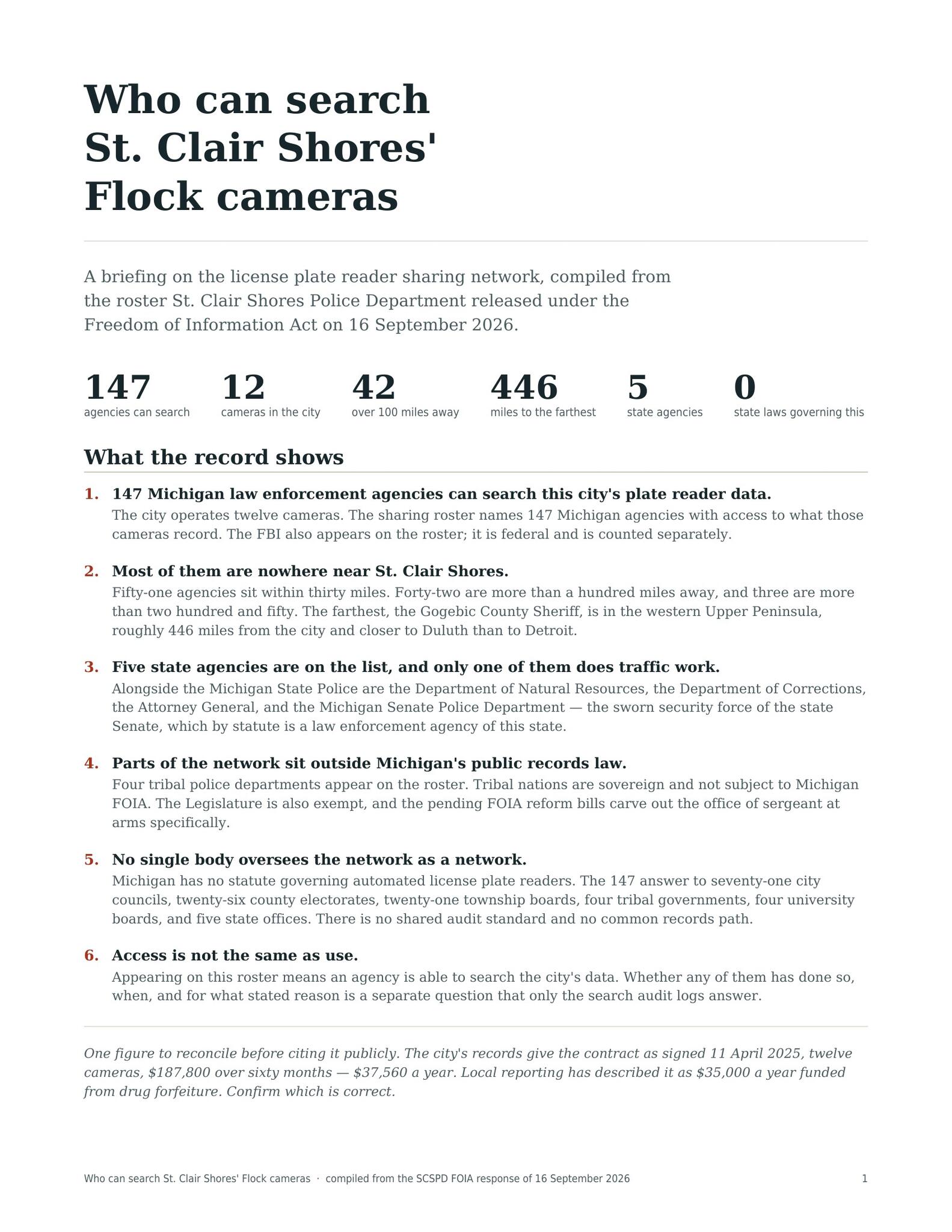
A community member on Nextdoor shared a careful six-page briefing dated September 16, 2026. The briefing says it was compiled from a St. Clair Shores Police Department response to a resident’s Michigan Freedom of Information Act request.
Its central finding is specific:
A roster supplied in the records identified 147 Michigan organizations authorized to search data from St. Clair Shores’ 12 Flock cameras.
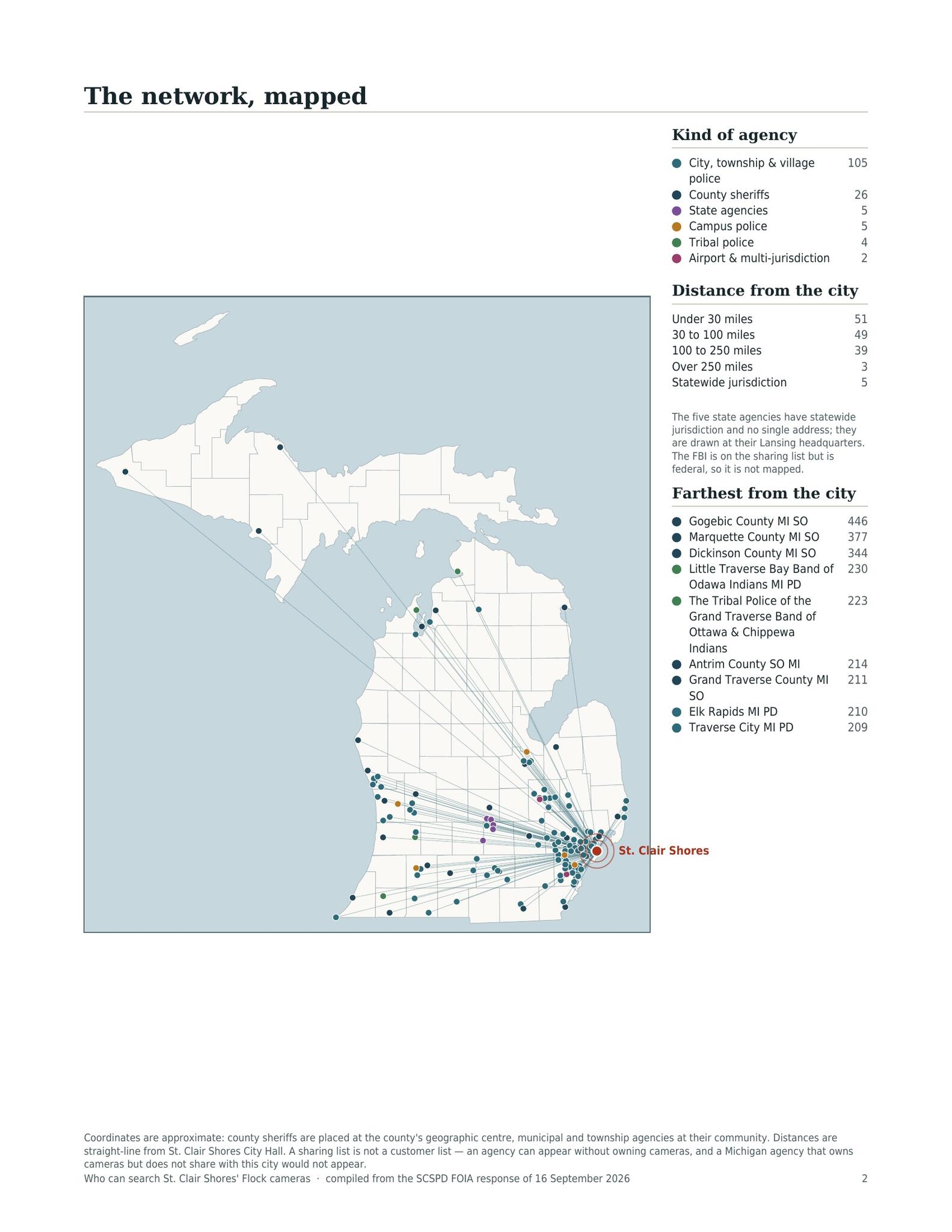
The reported roster includes:
- 105 city, township or village police/public-safety organizations;
- 26 county sheriffs;
- five state agencies;
- five university or college police departments;
- four tribal police departments; and
- two airport or multi-jurisdictional organizations.
The briefing maps 51 organizations within 30 miles of the city, 49 from 30 to 100 miles away, 39 from 100 to 250 miles away and three more than 250 miles away, plus five statewide agencies. It identifies the farthest as Gogebic County—about 446 straight-line miles from St. Clair Shores.
Examples on the reproduced roster include the Michigan Attorney General, Michigan Senate Police Department, Michigan Department of Natural Resources, Michigan Department of Corrections, Grand Valley State University Police, Western Michigan University Police and Eastpointe Police.
View the community briefing: summary →
Agency categories and questions →
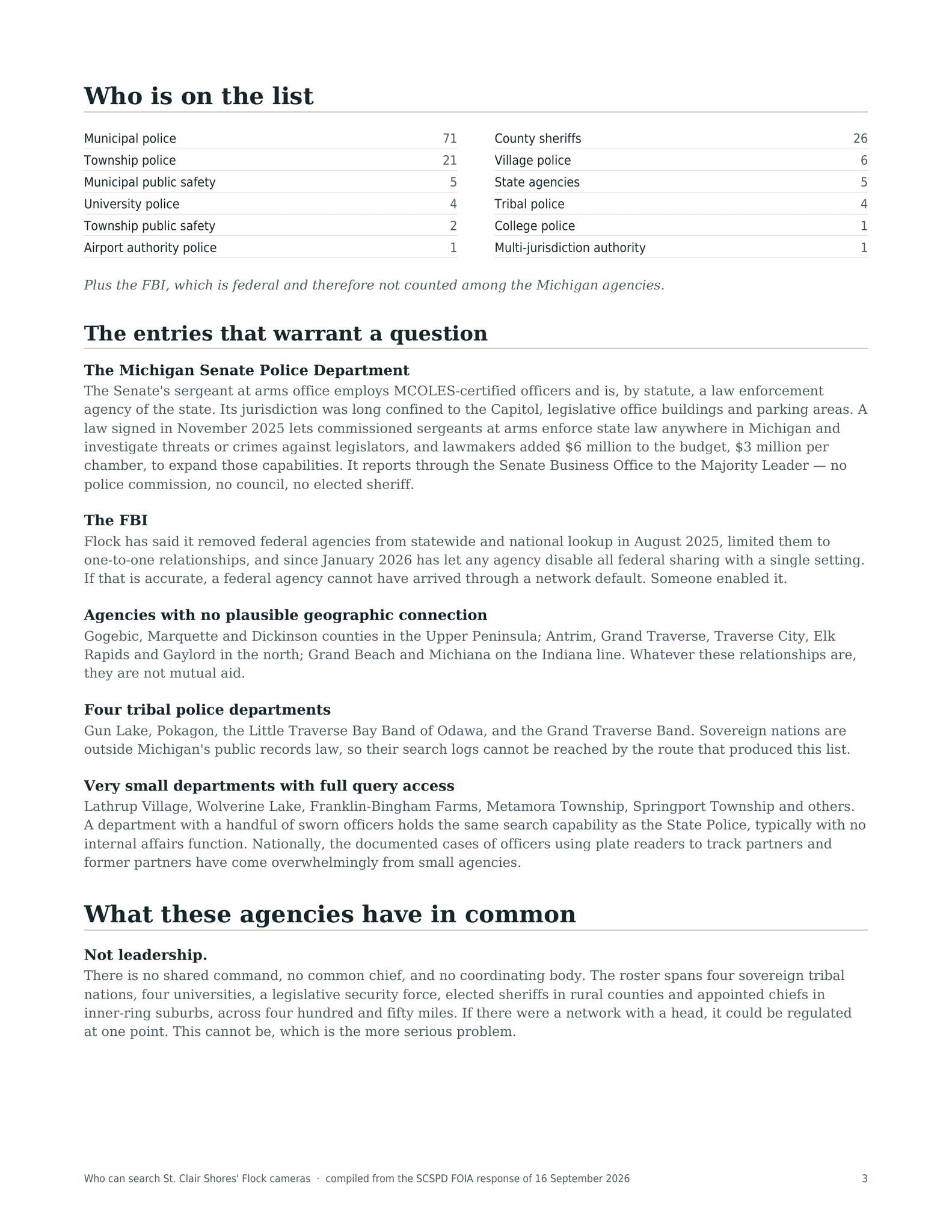
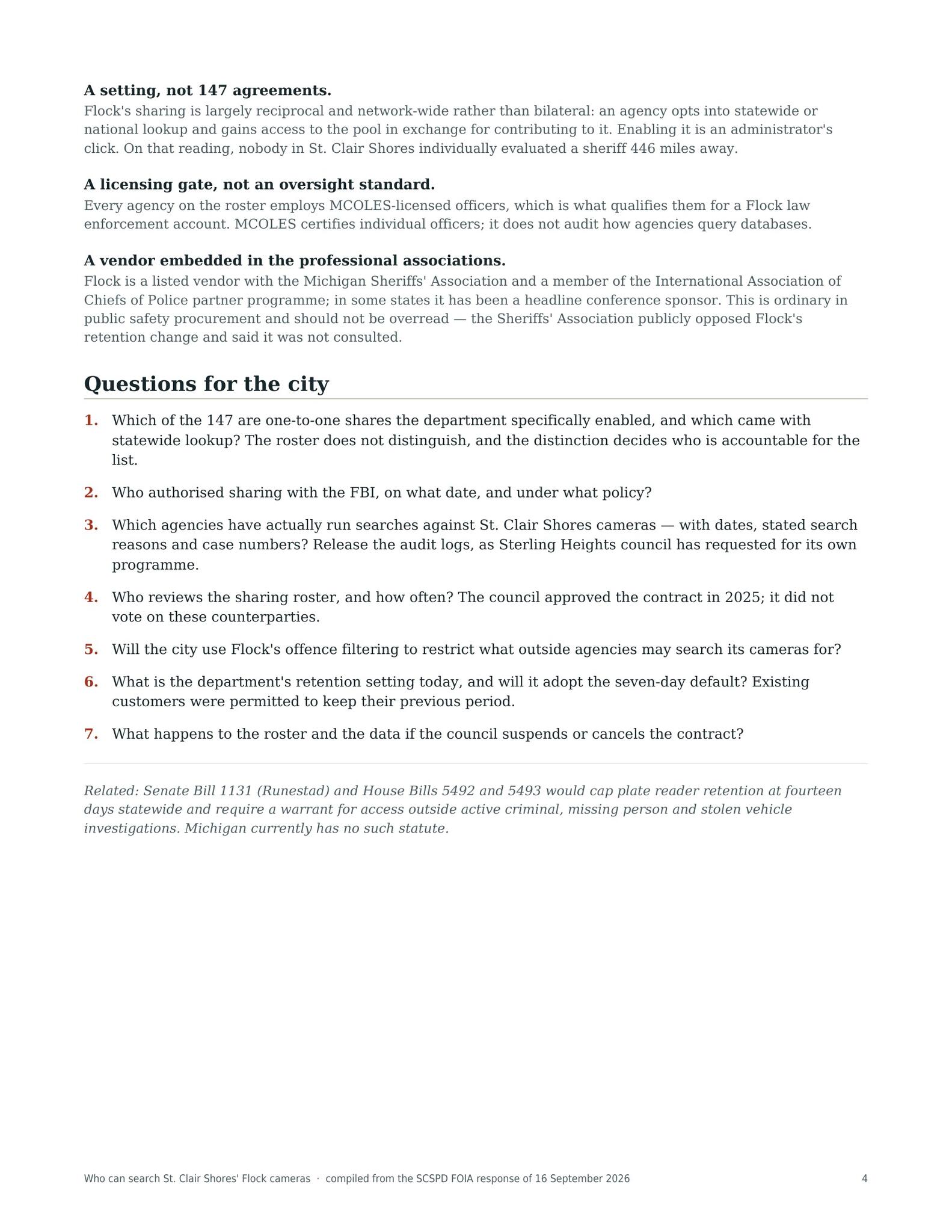
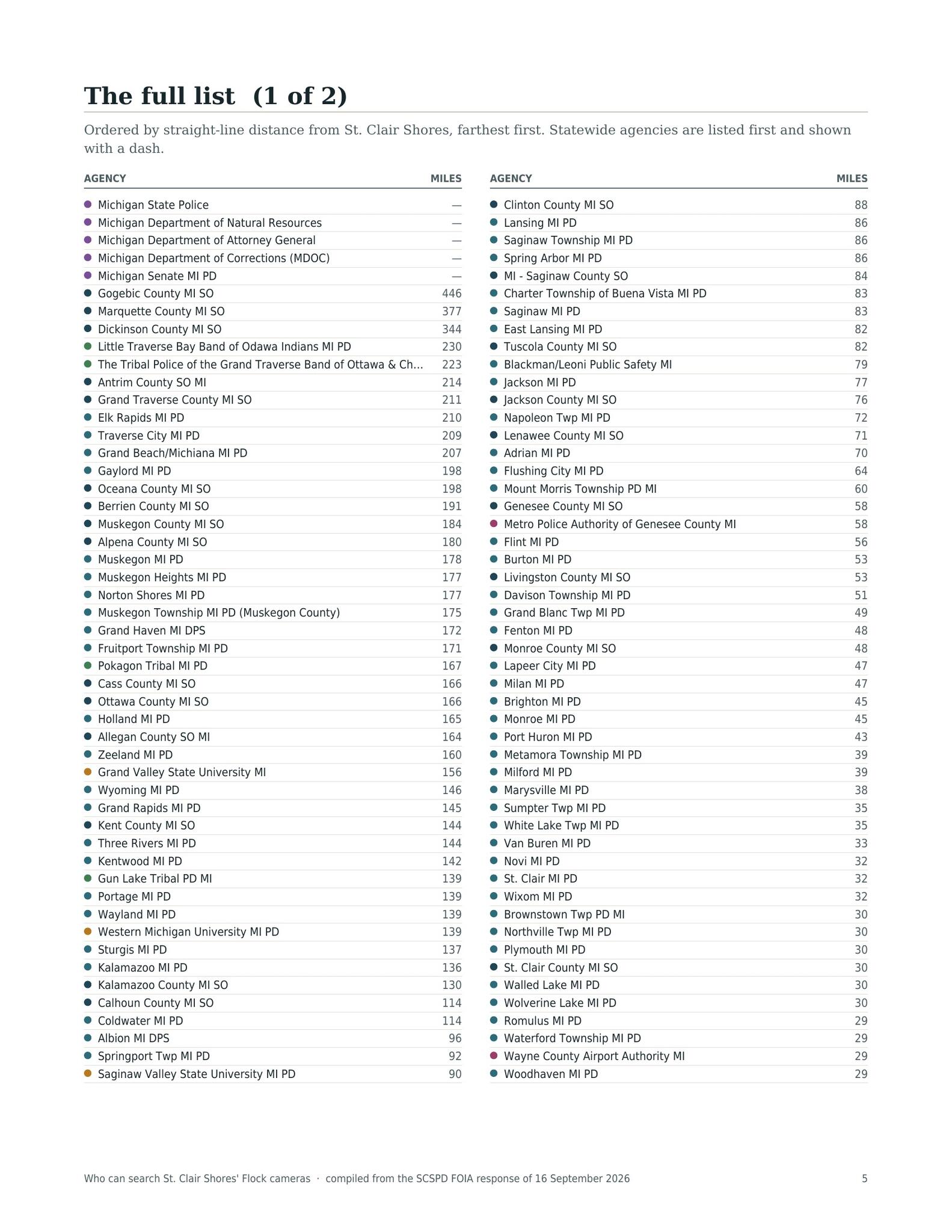
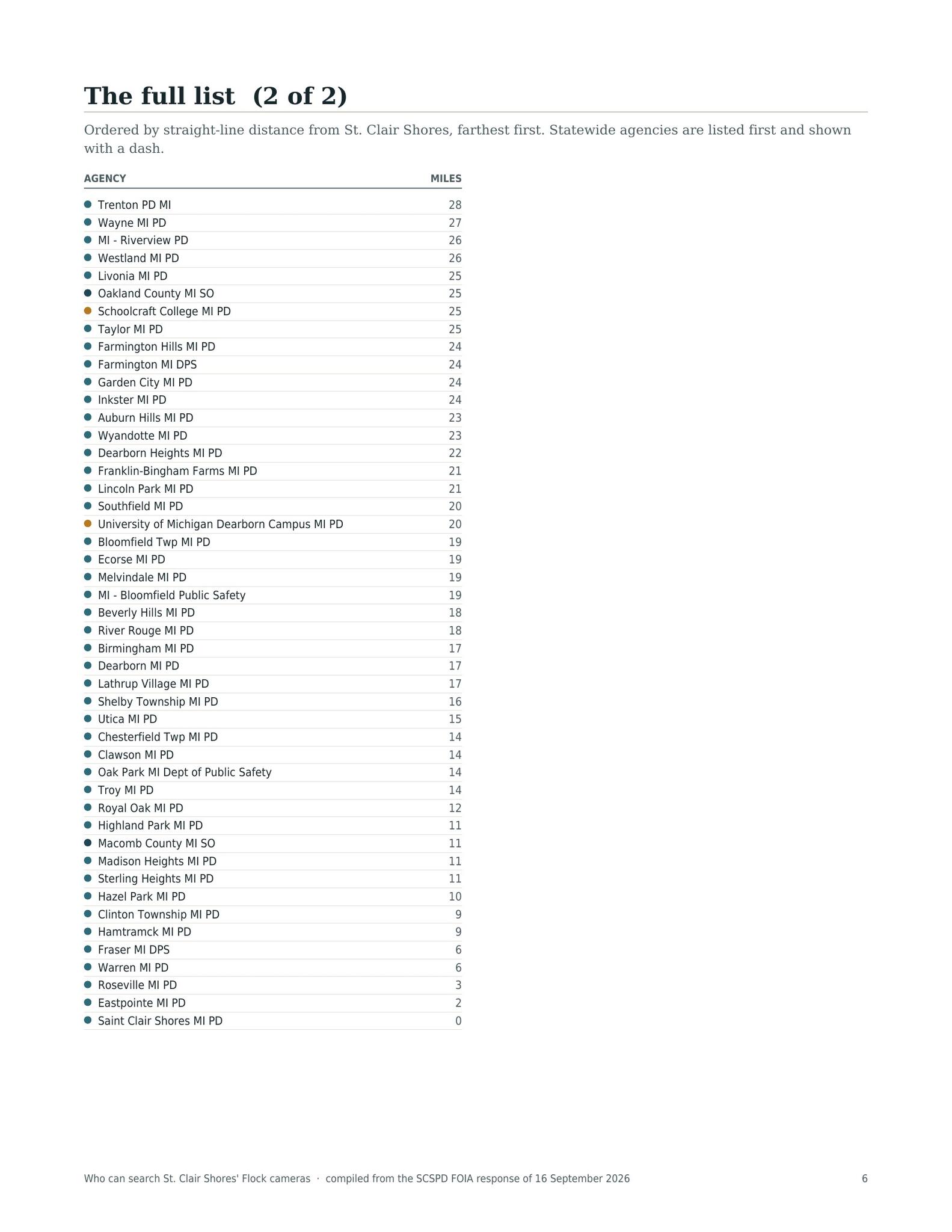
We credit the helpful community member anonymously. We have not received the underlying raw FOIA response, so we describe these images as a community-created briefing based on records, not as the city’s own publication. Obtaining the raw response and current platform export would strengthen the public record.
What “147 organizations” means—and what it does not.
The briefing itself makes two essential distinctions:
Access is not the same as use. Appearing on the roster means an organization was authorized to search St. Clair Shores camera data. It does not prove that the organization ran a search.
A network setting is not 147 separate agreements. The briefing describes Flock sharing as a reciprocal network configuration that can add organizations through an administrator setting. The roster does not show that council separately evaluated each distant sheriff, campus department or state agency.
This is why a sharing list and a search audit answer different questions:
- the sharing list shows who could search;
- user and role records show how many people could log in and with what permissions;
- audit logs show who actually searched, when and why; and
- exports and evidence records show what may have left routine vendor retention.
One organization may have multiple authorized users. On the other hand, a roster entry does not establish that every employee at that organization had access. The correct response is to obtain the role, account and audit records—not to inflate either side’s claim.
Understand access, sharing and retention →
Eastpointe is on the roster, but do not overclaim the connection.
Eastpointe’s police chief separately disclosed two employee-misuse findings in September 2026: one personal-purpose search and a second policy violation still under investigation at the time of disclosure. Eastpointe then voted 4–1 to terminate Flock.
Eastpointe’s appearance on the St. Clair Shores roster establishes that the department was an authorized sharing organization on the reported snapshot. We have not found evidence that either Eastpointe misuse incident involved St. Clair Shores data.
The focused public-record question is therefore:
Do St. Clair Shores audit logs show any Eastpointe user searching St. Clair Shores cameras, and if so, what dates, stated reasons, complaint numbers and review findings appear in the record?
Read the documented Eastpointe findings →
The September 21 council packet confirmed outside search access before the pause.
St. Clair Shores’ official amended agenda for Monday, September 21, 2026 at 7:00 p.m. listed “Flock Camera Update” as Item 10.a. Staff had recommended that council receive and file the update; the published packet did not advertise a termination or moratorium vote. Council nevertheless directed the six-month pause after hearing public concern.
The packet says authorized law-enforcement personnel in other jurisdictions using Flock may search for license plates or vehicle characteristics connected to crimes. It says that capability does not give those agencies “unrestricted access” to St. Clair Shores Police Department information.
That is compatible with the roster’s basic claim: outside organizations can be authorized to search city-camera data subject to platform, role and policy limits. The packet does not publish the 147-organization list or state how many individual external users that configuration represents.
The agenda provides two public-comment periods:
- two minutes on agenda items, with a form submitted to the clerk before the meeting starts; and
- five minutes during general audience participation later in the meeting.
The meeting was held at City Hall, 27600 Jefferson Avenue, St. Clair Shores, and was streamed through the city’s Media Center.
Official September 21 agenda packet →
What the city says about safeguards and results.
The September 21 packet reports:
- 12 cameras at city borders;
- a $36,000 annual subscription funded through the Drug Law Enforcement Fund;
- 30-day routine retention, with evidence retained under applicable procedures;
- individual logins and passwords;
- a complaint number or supervisor approval for vehicle-characteristic searches;
- monthly review by the Detective Bureau lieutenant;
- weekly review of searches Flock flags as suspicious; and
- 43 felony complaints in which the department says Flock assisted, including three armed robberies and a carjacking.
Those are the city’s current representations. They should be acknowledged and tested against the directive, configuration export, complete audit records and case-level methodology.
The packet’s attached presentation also says information sharing follows policy and law, while vendor “Myths & Facts” sheets describe local choice over sharing. That makes the local choice visible in the 147-organization snapshot a central policy issue—not a distraction from the system.
The original purchase received public discussion and a later approval.
Official city records show:
- a February 10, 2025 council work-study discussion of 12 proposed cameras;
- a March 17, 2025 amended agenda item to approve the Flock contract; and
- FOX 2 reporting that council approved the system 5–0 and that the city entered a five-year contract in 2025.
The February materials included a nonbinding 24-month quote with a $36,000 annual platform charge, $7,800 implementation charge and 90-day retention. That early quote is not safe to treat as the final controlling contract. The community briefing describes a later five-year contract signed April 11, 2025 and reports $187,800 over 60 months, while the current city packet lists $36,000 annually.
Priority record: publish the executed five-year order, master agreement, every amendment and invoice so residents can reconcile the controlling term, price, retention language, renewal and termination rights.
Official February 10 work-study packet →
Official February 10 proposed minutes →
Official March 17 approval agenda →
FOX 2: residents press St. Clair Shores to reconsider Flock →
Focused questions for council and police
- Publish the raw FOIA response and the current organization-sharing export. Which relationships are one-to-one, statewide-network, nationwide-network or federal?
- Who authorized the current sharing settings, on what date, under what written standard and with what council notice?
- How many outside user accounts can search St. Clair Shores data, by role and organization?
- Publish a privacy-minimized audit of actual outside searches: organization, date, stated reason, complaint number, search type and review result.
- Did any Eastpointe account search St. Clair Shores data? If so, were those searches reviewed after Eastpointe’s misuse findings?
- Publish the current ALPR Directive, configuration history, retention setting, monthly audits and weekly suspicious-search reviews.
- Reconcile the contract term and cost, and identify every termination, nonrenewal and data-deletion option.
- Publish the exact March 2027 review date early and place termination, removal, access closure and data disposition on the agenda as explicit decisions.
Our position
Monthly audits, required complaint numbers and shorter retention are better than no controls. The reported investigative outcomes also deserve accurate accounting.
They do not answer the basic policy question: should the movements of people not suspected of a crime be placed in a searchable system available across 147 organizations?
The safest way to prevent an authorized user, configuration change, weak review or future administration from misusing this location data is not to collect and network it in the first place.
One useful action: ask council now to publish the written pause instructions and schedule the March 2027 contract decision early enough for residents to obtain the contract and audit records before the vote.